Steps in Reverse-Engineering The PS2 November 24 2001 at 8:39 PM
Bill Gates III
I'm a software engineer but I have no time to reverse-engineer this unit right now. However, if I were someone trying to do it this is what I'd do:
1)Open the PS02 and figure out what kind of standard CPU is in there. Most commercial units are build around a few CPU cores (ex: StrongArm, etc). Each of these cores have their own instruction set and their own compiling tools. Get these tools and then try to figure out the binaries.
2)Figure out the embedded OS that is used. Again, there are a few standards in this field. Figuring out the OS will provide you with the tools to navigate the file systems and the data formats.
Although this looks simple, it is not that easy. There is a lot of tweaking involved. Fun tweaking, but Gee, I just don't have the time for this right now.
I just think that an HEX dump is not the best way to start such work. The fact of the matter is that the companies that build such devices use standard CPUs, development tools and editors. Maybe the guys at Zoom would be happy to provide this info.
Personally, I'm buying a ProTool TDM system and the first thing I'll is try to figure out how to write a plug-in to import my PS02 material faster than with the half-assed zoom editor.
Cheers,
This message has been edited by severe on Nov 27, 2001 8:27 AM
Well, the DSP is labelled as a Zoom ZFX-2 according to the autopsy photos we now have (thanks, Root5!)
The code is available for download if you want to take a crack at seeing what OS it has. If I were writing something like this there is no way I'd use someone elses embedded OS and I doubt Zoom did either (especially if they are not using off-the-shelf DSP parts). I don't know where to begin disassembling code that is targetted for an unknown processor, but if you can, I'll be happy to get involved with a complete rewrite of whatever parts need it once a complete disassembly is available. Let me know when you've finished.
Bill Gates IV (Ex-III, Ex-ex II, former # I)
I still think they used an off-the-shelf OS
November 26 2001, 7:17 PM
I know very few companies these days that write their own embedded OS. It is simply not worth the effort. Even TexasInstruments and Siemens have completly given up and are now standerdizing to a few well-known systems.
The devices we have today are little computers that are expected to behave just like real ones exept for the graphical display (but that too is changing).
In this space, the most important thing is speed of delivery and maintenability.
Anyway, I should probably look at the code instead of arguing There may lie the answer.
This message has been edited by severe on Nov 27, 2001 8:29 AM
Chris Hurley
code is at zoom
November 26 2001, 9:50 PM
You can download the system from www.zoom.co.jp
Re: Steps in Reverse-Engineering The PS2
November 28 2001, 8:02 AM
If it were me doing it I would just enter a dead simple 4/4 drum pattern then look at the binary. Go and make a couple of changes to the pattern and then compare this binary with the old one. You need to have a known starting point. You can quickly work out what is header / footer information and work out the rest.
Then slowly add effects / audio etc.
So what if it uses an off the shelf OS? Based upon the operating limitations imposed on the device, chances are the data storage is a custom file format which is what you need to decipher.
If it was BillG 3 doing it the machine would need three times the memory and would crash once a week <g>
Gary
Current Topic - Steps in Reverse-Engineering The PS2

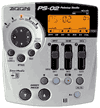


 There may lie the answer.
)window.location='http://www.rdrelectronics.com/dhc/ken/zoom/ps02/ps-02_012e.jpg')